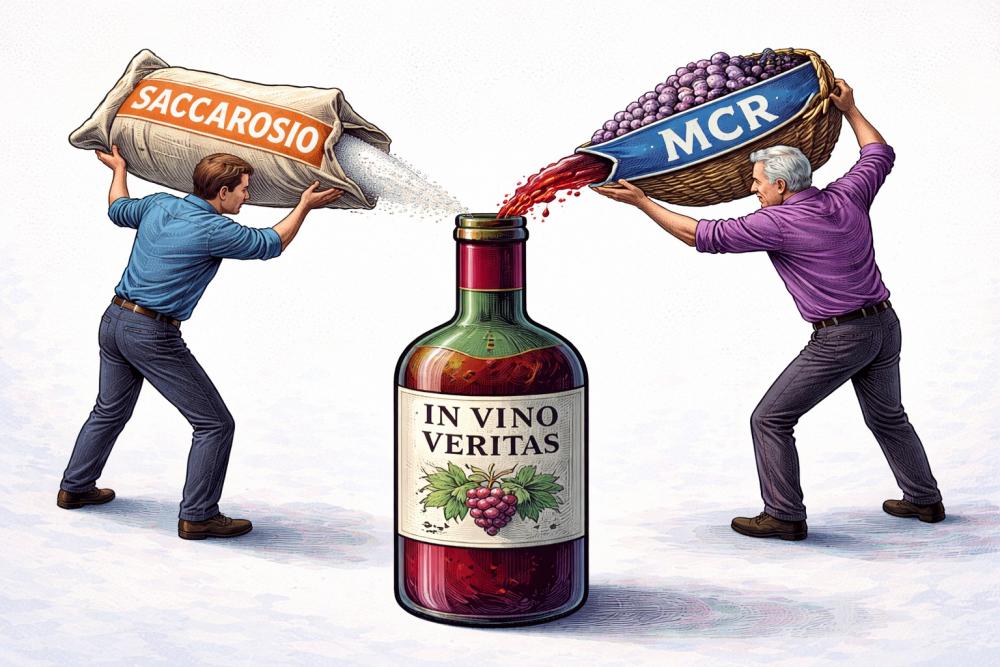
Federmosti: Transparency, Identity and Oenological Continuity in the Wine Supply Chain
Within the Italian and European wine sector, Federmosti today represents an authoritative voice promoting transparency and technical coherence throughout the entire wine production chain.
The association of Italian producers of concentrated must and rectified concentrated grape must, managed in outsourcing by Bertagni Consulting srl, was founded in 2009 at a crucial moment for the sector, following the 2008 reform of the EU Wine CMO. Origins: the CMO reform and the end of aid The 2008 reform of the Common Market Organisation for wine marked a turning point: it established the end of EU aid for concentrated must, without fulfilling the promise to ban chaptalisation the addition of sucrose to increase the alcoholic strength of wines. This scenario created a clear competitive asymmetry: companies using concentrated must, a direct derivative of grapes, found themselves disadvantaged compared to those relying on sucrose, which offered significant economic benefits but introduced a discontinuity within the wine supply chain. A battle for competitive balance Since its foundation, Federmosti has worked not only to protect the legitimate interests of companies in the sector, but above all to restore fair competitive conditions between: - companies enriching wines with concentrated must, derived from grapes - companies, particularly French ones, using sucrose, a sugar external to the wine supply chain It has been a long and intense battle, pursued with determination and without retreat, building alliances and amplifying its voice within the European context, also through the creation of a continental network: MUST. Acknowledging the impossibility of banning chaptalisation in certain countries particularly France, where it is considered a traditional practice Federmosti redirected its efforts toward a concrete objective: transparency in labelling. In vino veritas: the transparency campaign. This led to the launch of the In vino veritas campaign, based on a simple principle: consumers have the right to know the composition of wine. Federmostis request was clear labels should indicate the presence of sucrose or rectified concentrated grape must. This battle reached full satisfaction in 2023, with the new wine labelling system requiring wine producers to communicate ingredients and nutritional information. A significant success but not a final destination. From regulatory achievement to consumer awareness Federmostis objective now is to ensure that the reform reaches consumers. Without widespread dissemination of information, the victory risks becoming a Pyrrhic one. Today the association focuses its efforts on: - information campaigns - alliances with consumer associations - partnerships with forward-thinking wine producers - promotion of transparency along the supply chain The goal is to make consumers truly aware that, indeed, in vino veritas. Oenological continuity and wine identity The issue is not only regulatory or economic, but also technical and identity-related. Wine originates from grapes and must be made from grapes and their derivatives: this is the definition of wine provided by the OIV. Interrupting this continuity means altering the coherence of the supply chain. The first fermentation is an identity-defining act: it determines structure, balance and aromatic profile. Every subsequent choice has technical and sensory implications. Yet, in the secondary fermentation or dosage of many European wines and sparkling wines, sucrose is still used a sugar external to the wine supply chain. This is not merely a regulatory issue. It is a matter of technical coherence and product identity. The supply chain can remain linear: grape must rectified concentrated grape must wine A continuity that preserves: - varietal identity - sensory coherence - fermentation stability - narrative transparency When sugar also derives from grapes, wine remains faithful to its origin. It is a choice that combines technique, ethics and clarity for consumers. The future: transparency and supply chain linearity Federmosti′s new objective is therefore clear: to make transparency a widespread practice understood by consumers, strengthening a linear and coherent supply chain. Because the issue is not only about communication. It concerns the linearity of the supply chain and the very nature of the product. The wine is born from grapes. Why interrupt its oenological continuity? When sugar also comes from grapes, wine remains itself. 100% from grapes.